Unclassified // For public releaseRELEASE 001 — OXCART — In developmentDoc. BSB/PUB/26-01
BLACKSITE BOYS
Program 002*BSB-1977-005*

Have Blue

Designation
Stealth technology demonstrator
Location
Groom Lake
Nevada Test and Training Range
Period
1976–1979
Status
Successful. Both airframes lost.
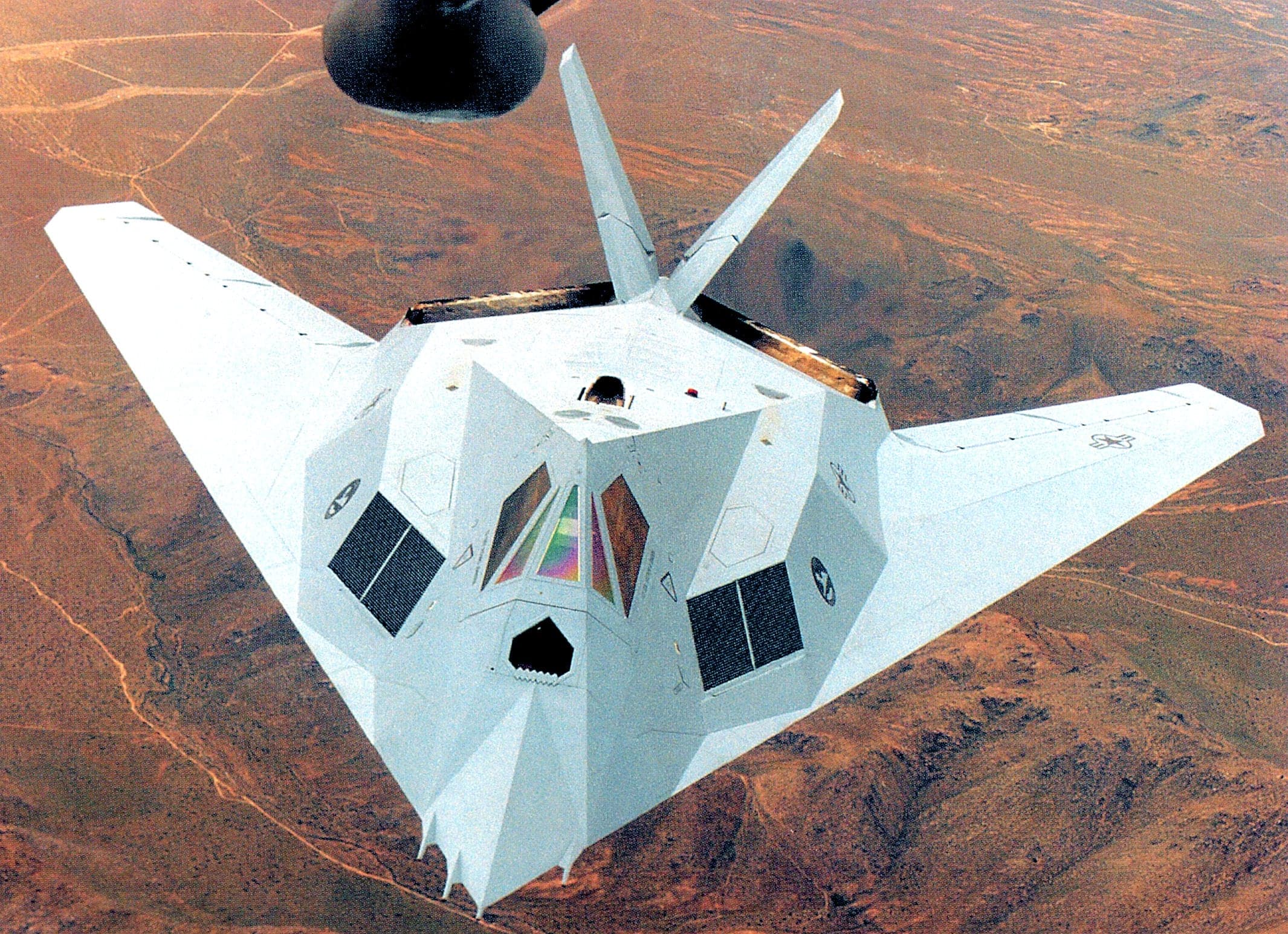
Lockheed Have Blue stealth prototype in flight, seen from below
PL. 01Lockheed Have Blue stealth prototype in flight, seen from belowU.S. Air Force (via San Diego Air & Space Museum archives)

Summary

Two were built. Neither survived the test program. Between them they proved that an aircraft could be made almost invisible to radar, and then they were buried.

Objective:
Make an aircraft nearly invisible to radar.
Method:
Flat surfaces. Calculated angles.
Airframes built:
Two.
Airframes remaining:
None.
Status:
Successful.

By the mid-1970s the problem was simple to state. Soviet air defenses had become good enough that aircraft flying into them were not expected to come back. The Defense Advanced Research Projects Agency asked industry whether an aircraft could be made so hard to see on radar that it would not matter.

Lockheed’s Skunk Works joined the competition late. Its answer came from a mathematician named Denys Overholser and a paper published in Moscow in 1962 by the Soviet physicist Pyotr Ufimtsev, which described how to predict the way radar waves scatter from the edges of a flat surface. The Air Force’s Foreign Technology Division had translated it in 1971. It was, in effect, available to anyone.

The method had a limit. The computers of the day could only calculate reflections from flat panels, so the aircraft would have to be built from flat panels. The result, a faceted shape the engineers called the Hopeless Diamond, looked nothing like an aircraft and was not obviously capable of flight.

“Our old D-21 drone has a lower radar cross-section than that goddamn diamond.”
— Kelly Johnson, founder of the Skunk Works

A model was mounted on a pole on a radar range. Johnson was wrong. He paid Ben Rich, who ran the Skunk Works, a quarter.

$0.25Settled between Kelly Johnson and Ben Rich after the radar test.

§ 01Borrowed parts

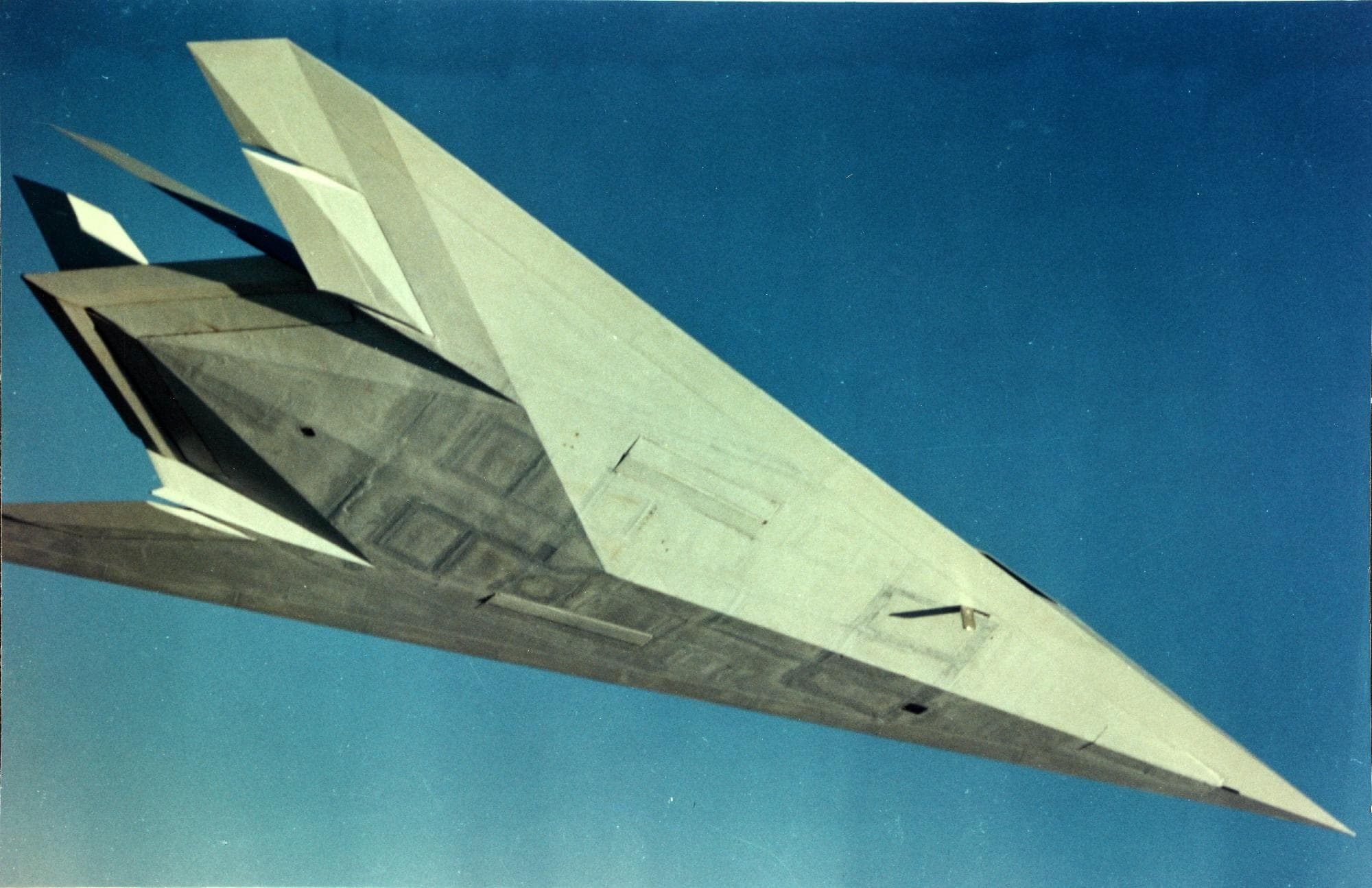
Two flying demonstrators were ordered under the name HAVE BLUE. To save time and money they were assembled largely from parts already in the inventory: engines from the T-2 Buckeye trainer, a fly-by-wire flight control system from the F-16. The finished aircraft was 47 feet 3 inches long, with a wingspan of 22 feet 6 inches and two inward-canted tails.

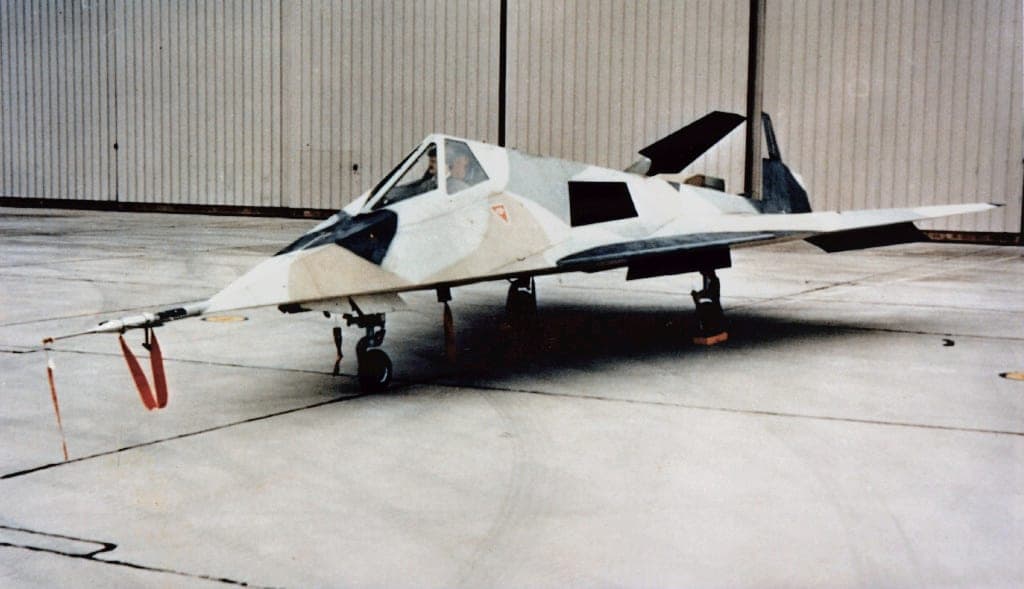
It was painted in a three-tone camouflage — not to hide it from radar, which it managed on its own, but to stop people on the ground from noticing the facets.

Dwg. BSB-77-005-A47'-3"22'-6"72.5°Air data probeCanopyFlat-glazed, coatedInlet gridTails canted inwardPlanFrontSideHB1001 / HB1002 — Lockheed ADP — 1977
FIG. 01HB1001, planform and elevation. Every surface flat.Scale 1:96

§ 02Groom Lake

HB1001 first flew on 1 December 1977 at Groom Lake, Nevada, with Lockheed test pilot Bill Park at the controls. On 4 May 1978, on its thirty-sixth flight, it landed hard, Park was ordered to climb away and eject, and he was seriously injured.

HB1002, flown by Air Force test pilot Ken Dyson, carried on with the radar trials against which every later stealth aircraft would be measured. It was lost on 11 July 1979, on its fifty-second flight, after a fire. Dyson ejected safely.

The wreckage of both aircraft was buried on the Nevada ranges. The program had already done what it was for. In November 1978, before the second crash, the Air Force had ordered the aircraft that became the F-117 Nighthawk. Its existence was acknowledged ten years later, on 10 November 1988.
[A]

Chronology

07 entries
  1. DARPA awards Phase 1 XST contracts of $1.5 million each to Lockheed and Northrop.
  2. Lockheed selected to build two demonstrators: HAVE BLUE.
  3. HB1001 first flight, Groom Lake. Bill Park.
  4. HB1001 lost on its 36th flight. Park ejects.
  5. Full-scale development of the F-117 ordered.
  6. HB1002 lost on its 52nd flight. Dyson ejects.
  7. Air Force acknowledges the F-117.
[B]

Plates

03 additional
Lockheed Have Blue stealth technology demonstrator parked outside a hangar, in disruptive camouflage
PL. 02HAVE BLUE outside a hangar, three-tone camouflage appliedU.S. Air Force
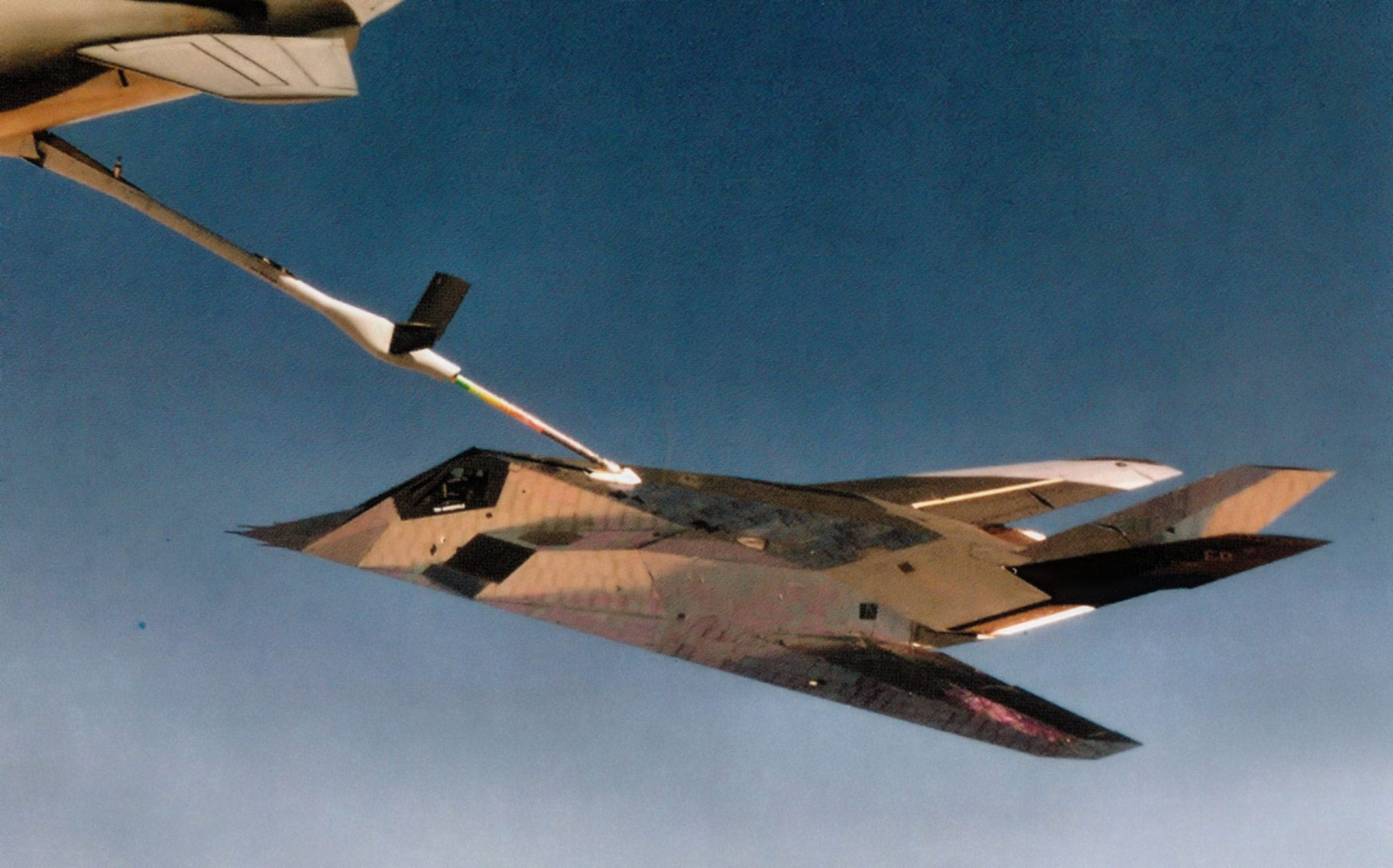
Early Lockheed F-117A (79-10784) refueling from a KC-135 during the program's classified period
PL. 03What it became: an early F-117A refuelling, July 1983, five years before it officially existedU.S. Air Force
Lockheed F-117A of the secret 4450th Tactical Group in experimental gray scheme
PL. 04F-117A of the 4450th Tactical Group, 1986U.S. Air Force
[C]

Documents in this file

01 items
DOC 01

Method of Edge Waves in the Physical Theory of Diffraction

Origin
P. Ya. Ufimtsev, Moscow. Translated by USAF Foreign Technology Division, 1971
Date
1962

Scan pending. Reference retained for the record.

[D]

Sources

Public record
  1. Ben R. Rich & Leo Janos, Skunk Works: A Personal Memoir of My Years at Lockheed (Little, Brown, 1994)
  2. P. Ya. Ufimtsev, Method of Edge Waves in the Physical Theory of Diffraction (1962; FTD translation 1971)