Unclassified // For public releaseRELEASE 001 — OXCART — In developmentDoc. BSB/PUB/26-01
BLACKSITE BOYS
Program 003*BSB-1978-006*

Stargate

Designation
Remote viewing for intelligence collection
Location
Fort Meade
Maryland
Period
1977–1995
Status
Terminated
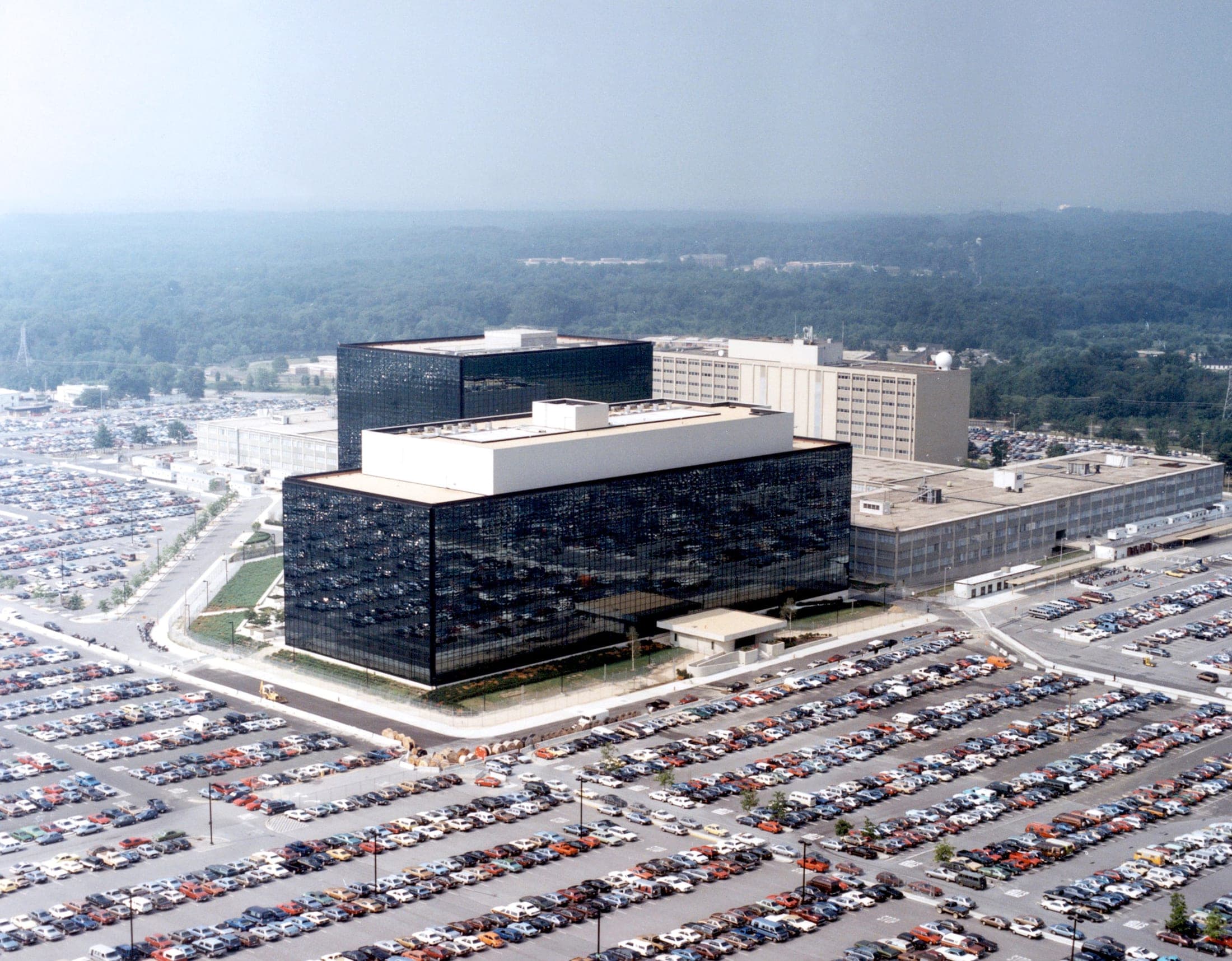
Aerial view of National Security Agency headquarters, Fort George G. Meade, Maryland
PL. 01Fort George G. Meade, Maryland. The unit’s barracks is not visibleNational Security Agency

Summary

The program went through six codenames, three agencies and one formal evaluation. The evaluation was the last thing it did.

Objective:
Collect intelligence by psychic means.
Personnel:
15–20 at peak. Three at the end.
Facility:
A wooden barracks. It leaked.
Finding:
Never used to guide an intelligence operation.
Status:
Terminated.

In the early 1970s American intelligence learned that the Soviet Union was funding research into psychic phenomena. It concluded that it could not rule out the possibility that the research might work, and began funding some of its own.

The work began in 1972 at the Stanford Research Institute in California, under the name SCANATE — scanning by coordinate. Two laser physicists, Russell Targ and Harold Puthoff, tested subjects including the artist Ingo Swann, who was given map coordinates and asked to describe what was there. The technique was called remote viewing.

In 1977 the Army set up its own unit, which over the following eighteen years was renamed GONDOLA WISH, GRILL FLAME, CENTER LANE, SUN STREAK and, from 1991, STAR GATE. Responsibility passed to the Defense Intelligence Agency. At its peak the unit had fifteen to twenty people. It worked out of an old wooden barracks at Fort Meade, Maryland, which leaked.

6Codenames, 1972–1995.

§ 01Targets

Viewers were given a target — a sealed envelope, a photograph, a set of coordinates — and produced sketches and written impressions. Most targets were conventional intelligence problems: facilities, hostages, missing aircraft. Some were not.

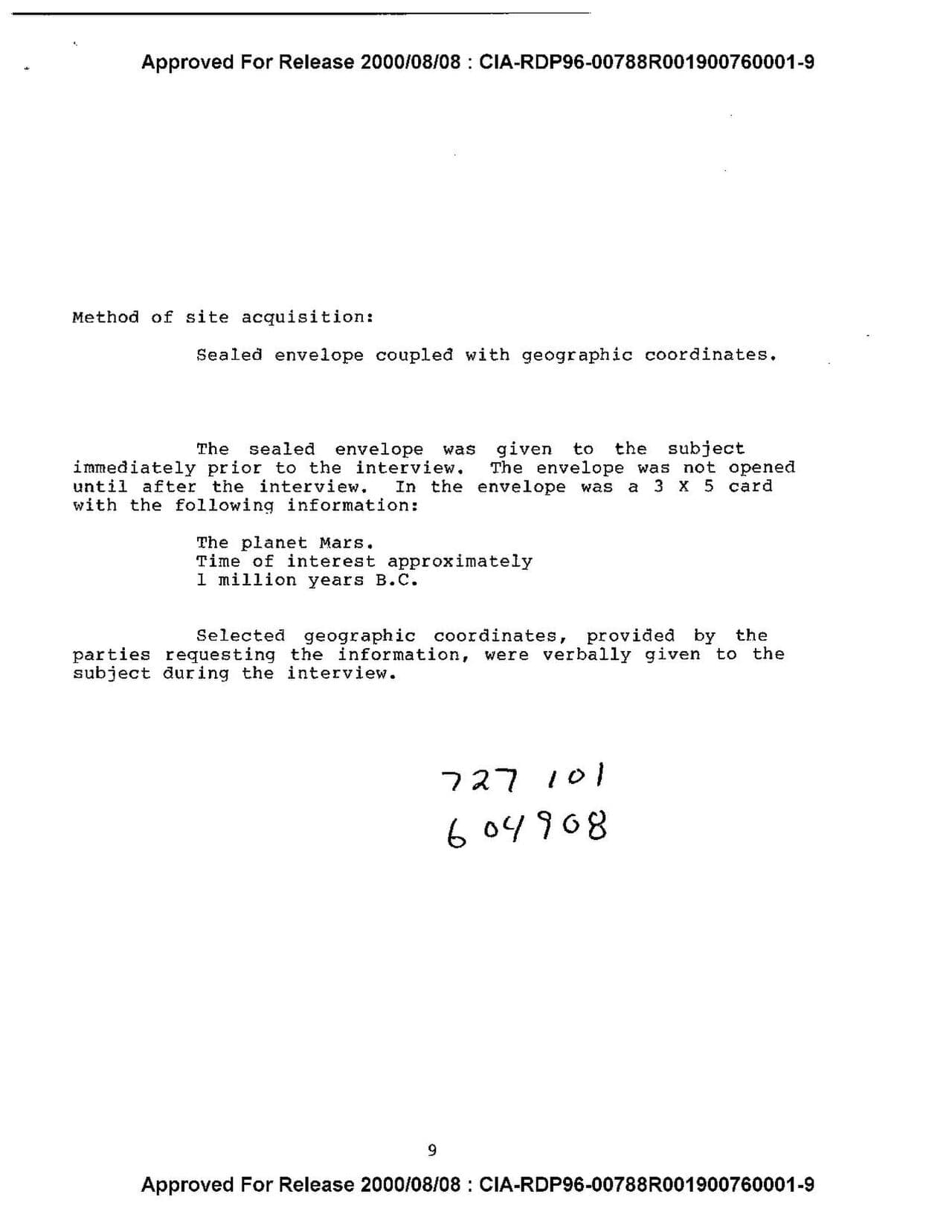
On 22 May 1984 a viewer was given a sealed envelope and a pair of coordinates: 40.89 degrees north, 9.55 degrees west. The card in the envelope read: “The planet Mars. Time of interest approximately 1 million years B.C.”

Ten minutes in, the viewer reported “an oblique view of a ah..pyramid or pyramid form.” It was, he added, “yellowish, ah...okra colored.” The transcript was approved for release on 8 August 2000.
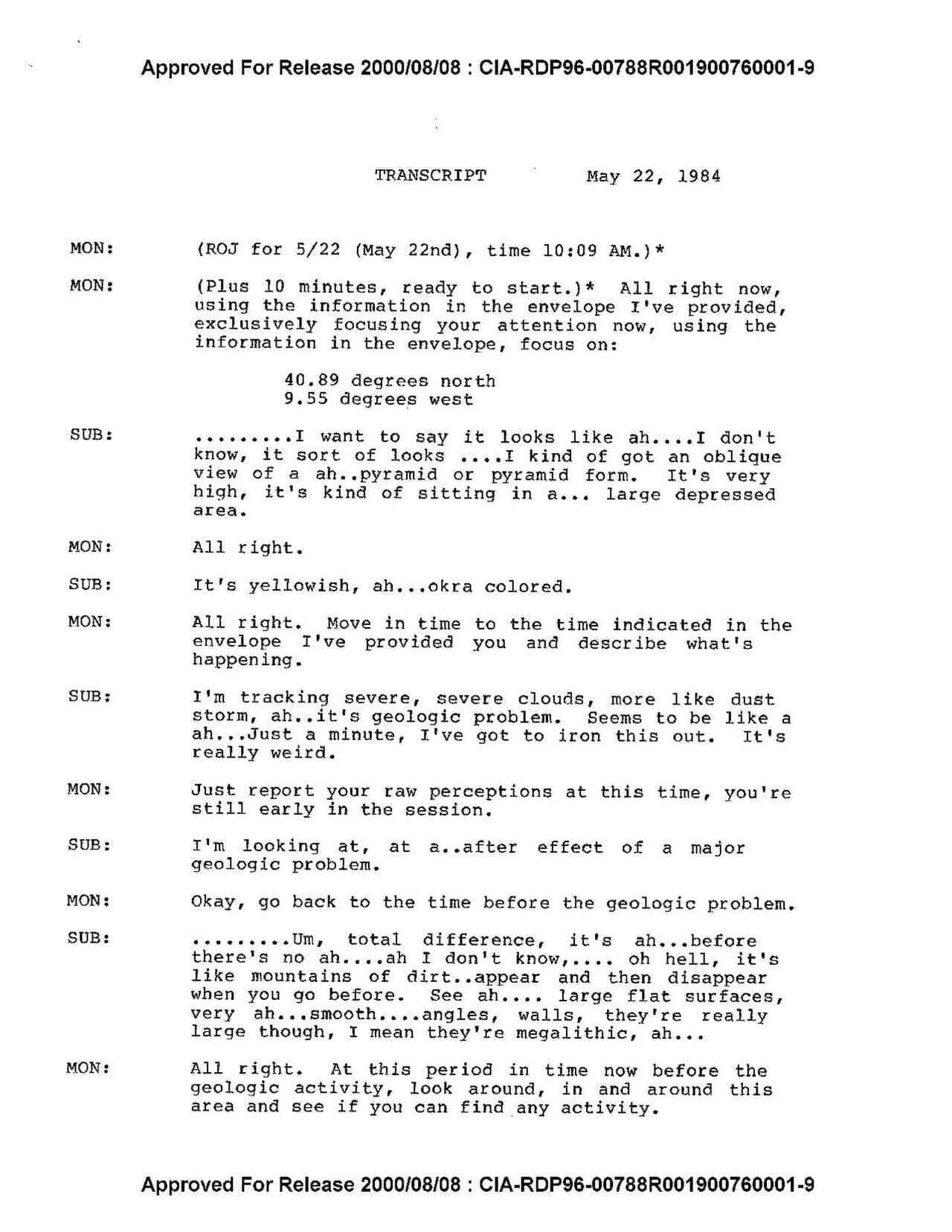
Declassified remote-viewing session transcript 'Mars Exploration' from the CIA STAR GATE collection (CIA-RDP96-00788R001900760001-9)
DOC 01 — Primary sourceMars Exploration — session transcript
TranscriptionDOC 01

40.89 degrees north

9.55 degrees west

Origin
CIA Records Search Tool (CREST)
Date
22 May 1984
Ref.
CIA-RDP96-00788R001900760001-9
View source
Dwg. BSB-78-006-ASessionDateViewerTarget ref.Stage I — IdeogramA: — B: —Stage II — SensoriesTextureTemperatureColorSoundAmbienceStage III — DimensionalsAOLAOL breakSummaryFeedback: withheld
FIG. 01Session sheet, schematic reconstruction. Target reference withheld.Scale None

§ 02Evaluation

In 1995 the program was transferred to the CIA, which commissioned an outside review from the American Institutes for Research. Two evaluators were appointed. The statistician Jessica Utts concluded that the laboratory results showed an effect that chance could not explain. The psychologist Ray Hyman disagreed, and described the output as “vague, general, and way off target.”

On the question that mattered, the review agreed with itself: remote viewing had never produced information used to guide an intelligence operation. The program was terminated in 1995, having cost about $20 million. In January 2017 its records went online with the rest of the CIA’s declassified archive, where anyone can read them by ordinary means.
[A]

Chronology

10 entries
  1. Research funded at Stanford Research Institute (SCANATE).
  2. Army unit established: GONDOLA WISH.
  3. Renamed GRILL FLAME.
  4. Renamed CENTER LANE.
  5. Session: target card reads “The planet Mars.”
  6. Renamed SUN STREAK under the Defense Intelligence Agency.
  7. Renamed STAR GATE.
  8. American Institutes for Research evaluation delivered.
  9. Program terminated.
  10. Records published online via CREST.
[B]

Plates

01 additional
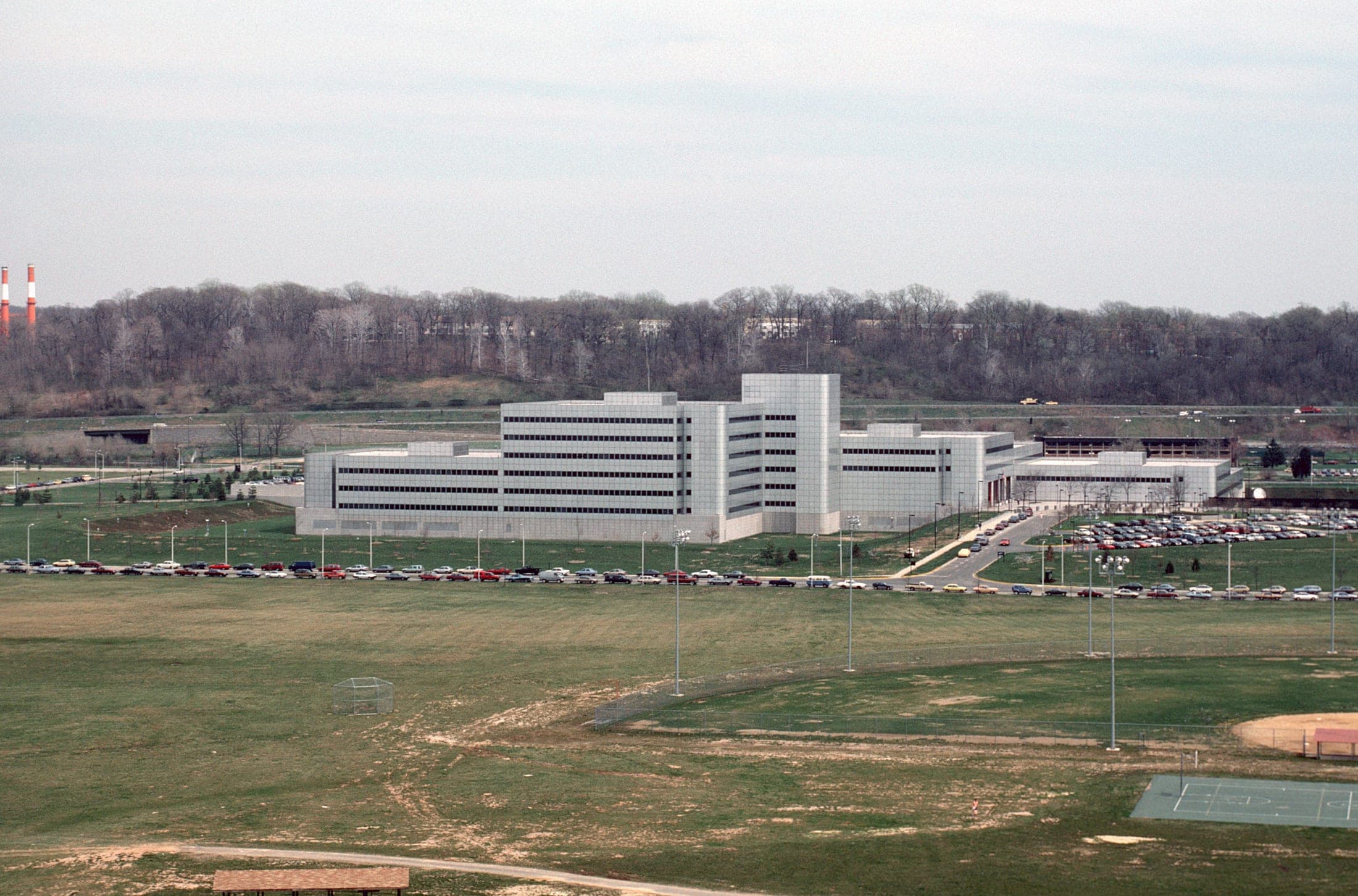
Aerial view of Defense Intelligence Agency headquarters at Bolling Air Force Base, Washington, D.C.
PL. 02Defense Intelligence Agency headquarters, 1988U.S. Air Force (MSgt Ken Hammond)
[C]

Documents in this file

03 items
Declassified remote-viewing protocol page — 'Method of site acquisition: sealed envelope' — from the CIA STAR GATE collection
DOC 03

Mars Exploration — method of site acquisition

Declassified remote-viewing protocol page — 'Method of site acquisition: sealed envelope' — from the CIA STAR GATE collection

Origin
CIA Records Search Tool (CREST)
Date
22 May 1984
Ref.
CIA-RDP96-00788R001900760001-9
DOC 02

An Evaluation of Remote Viewing: Research and Applications

Origin
American Institutes for Research
Date
29 Sep 1995

Scan pending. Reference retained for the record.

[D]

Sources

Public record
  1. CIA Reading Room — STAR GATE collection (CREST)
  2. M. D. Mumford, A. M. Rose & D. A. Goslin, An Evaluation of Remote Viewing: Research and Applications (AIR, 1995)